显示标签为“where to buy fiber optic cable”的博文。显示所有博文

2013年9月23日星期一

How to Choose Fibre Optic Cable Manufacturers


If you get a fiber optic cabling project on hand, you must know what fiber optic equipment is needed. Use structured fiber optic cables and cabling components are very important. Cabling is the foundation of your network, if the cabling fails, nothing else will matter. For a given grade or category of cabling, you'll see a range of price, but the highest prices don't necessarily mean the highest quality. Buy based on the manufacturer's reputation and proven performance is essential, here comes the title of this article how to choose fibre optic manufacturers, see some tips on this regarding this question.
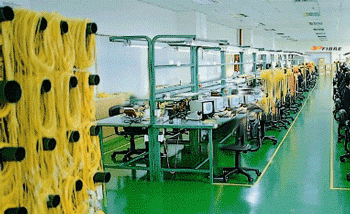
fibre optic cable manufacturer
Reasonable price
Price is the first factor that we should take into consideration. Price of fiber optic products is commonly higher than other industrial products.Take fiber optic cable for example, price of fiber optic cable is calculated by meter & foot. The minimal length of fiber optic cables is 3 meters, larger projects may need thousands of meters, which will result in a huge cost on fiber cables. When buying online, you will see most fiber optic cable vendors list the fiber optic cable price per foot, you can compare three or more store to choose the most proper one.
Excellent quality
Most expensive prices do not mean the best quality, that's true, while the cheapest is more likely sacrifice to quality. So it is hard to judge the quality of fiber optic cable just by how much of the seller priced them. You need to do something by yourself now, check out the customer reviews on the products. Good vendors are willing to open the review functions online if they are confident with their products, so find out several such web-store and compare the satisfaction, although this cannot include all, it's helpful for reference!
If you have enough time and patience, you are also suggested buying a small sample before placing a big order.
Technical supports & Good customer service
Customer service is another important point that determine your fiber optic cable manufacturer is good or not. Power company always invests huge to build professional technical supports and
customer service teams, which are also the software of a company. Make some inquiries before buying, on general issues or technique issues, you will soon check out their service level, it is necessary to do the test before buying other than after-sales.
Warranty policy
It is well known that stuff bought online should be guaranteed, otherwise, you will lose you money easily. The warranty period of the products is varied from different sellers.Take fibre optic cable manufacturers for example, some vendors guarantee weeks, or months of the exchange of refund. Some are one or two year, which is very usual. But if you see a company that gives you a lifetime warranty, why not choose the lifetime warranty one to the years or month ones? The longer their warranty period is, the more reliable their products would be. No one is willing to pay more than the earned after sale, only if the quality is unbeatable enough!
Reputation of the supplier
Last but not the least, check the reputation of your possible fiber optic cable supplier is also important, this is especially necessary when doing purchase online. Enter the name of your supplier like "FiberStore" in Google, you will see many informations related to this company, check this informations about their social network account, forum talking topics, products reviews, or even the latest news or activities, the general impressions of this company will form on your mind.
Above only listed several typical aspect that you need to take to judge your fiber optic cable suppliers, some other points are also important if you want to rigorous decision on where to buy fiber optic cable, keeps an eye on the new products updating frequency of the supplier, their custom capability for your special requirement. Powerful fibre optic cable manufacturers always keeping research and develop new products and keep pace with the latest industrial technologies!

2013年9月12日星期四

Pre Order FAQs Regarding Buying Fiber Optic Cables


Fiber optic cable is a large, long-distance optical signal transmission unit, by means of which we can spread out the various optical signals with low attenuation rate to meet signals transmission needs between different fields. There are more than 15.000 varieties of fiber optic cables in the telecommunication field. Choosing the right fiber optic cable is extremely important for any installation. Purpose of the cable is to protect the fibers during installation and the service lifetime. This article is written to address your concerns regarding what types of fibers do you need, where they will be installed, and where to buy fiber optic cable.
buying fiber optic cable
What types of fiber should I choose and how many fibers?
It may be familiar for you that optical fibers are divided into two different mode which is multimode and single mode.
Single-mode has a core that is 8.3 microns in diameter. Single-mode fiber requires laser technology for sending and receiving data. With a laser used, light in a single-mode fiber also refracts off the fiber cladding. Single-mode has the ability to carry a signal for mile, making it ideal for telephone and cable television on providers.
Multimode fibers, as the name suggests, permits the signals to travel in multiple modes, or pathways, along the insides of the glass strand or core. It is available with fiber core diameters of 62.5 and a slightly smaller 50 micron. 62.5 micron multimode is referred to as OM1. 50 micron fiber is referred to as OM2, OM3 and the recently added OM4. OM4 has greater bandwidth than OM3 and OM3 has greater bandwidth than OM2.
While single-mode has a core that is 8.3 microns in diameter. Single-mode fiber requires laser technology for sending and receiving data. With a laser used, light in a single-mode fiber also refracts off the fiber cladding. Single-mode has the ability to carry a signal for mile, making it ideal for telephone and cable television on providers. Fifty micron OM3 fiber is designed to accommodate 10 Gigabit Ethernet up to 300 meters, and OM4 can accommodate it up to 550 meters. Therefore, OM3 and OM4 fiber are always chosen over the other glass types. In fact, nearly 80% of 50 micro fiber sold is OM3 or OM4
Except the fiber mode, the number of fibers are necessary to know. Usually, unless you are making patchcords or hooking up a simple link with two fiber, it is highly recommended that you include a number of spare fibers. Corporate network backbones are often 48 fibers or more. Most backbone cables are hybrids - a mix of 62.5/125 multimode fiber for today’s networks and single-mode fiber for future networks. If the slowest network planned today is as gigabit speeds, it might even be better to us the new 50/125 multimode fiber optimized for the laser sources used in gigabit networks.
Where they will be installed, indoor, outdoor or both?
Outdoor cables are designed to protect the fibers from years of exposure to moisture. Until recently, your only choice for outdoor cables was loose-tube, gel-filled cables. But now you can buy dry water-blocked cables similar to indoor designs that are easy to terminate without breakout kits, saving incredible amounts of time. In a campus environment, you can even get cables with two jackets: an outer PE jacket that withstands moisture and an inner PVC jacket that is UL-rated for fire retardancy. You can bring the cable into a building, strip off the PE jacket and run it anywhere, while normal outdoor cables are limited to 50 feet inside the building.
Indoor cables are what we called “tight-buffered” cables, where the glass fiber has a primary coating and secondary buffer coatings that enlarge each fiber to 900 microns - about 1 mm or 1/25- inch- to make the fiber easier to work with. These cables can be directly terminated.
The most popular cable for indoor use is distribution cable, which has a number of 900-micron buffered, color-coded fibers inside a single jacket. It’s the smallest and lightest cable, and each fiber is sturdy enough for direct termination. Another choice for indoor use is the breakout cable, which is just a bunch of simplex cables inside a common jacket for convenience in pulling and ruggedness.
Where to buy fiber optic cable
Once knowing what kind of fiber optic cables is needed, last but not least is to decide where to buy your required fiber optic cables. In the actual production of fiber optic cable, materials which is wearable, radiation proof and adaptable to temperature is very important. Good core material and the external packages. When buy fiber optic cable, qualification of the fibre optic cable manufacturers should been taken into consideration, choosing qualified and professional manufacturers will ensure you quickly get the problem resolved after the sale.
Prepared to make the order? Click to know the fiber optic cable price per foot