2013年10月14日星期一

FiberStore Plug-and-Play Solutions


Broadcast facilities operate at very high levels of reliability and demand design flexibility to easy accommodate frequent adds and changes to equipment. Managing thousands of cables, should always be a high priority for the network engineer - particularly for maximizing system performance and uptime.
FiberStore plug-and-play solutions are designed to address the reliability, scalability, and thermal needs of today's mission-critical master control. These solutions promote increased reliability of broadcast centers through properly managed and scalable cable density, which encourages proper airflow and reduces overall installation and maintenance costs.
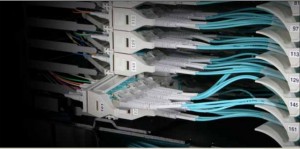
FiberStore latest introduced optical distribution frame with plug-and-play (MPO) cassettes is the highest density optical distribution frame solution available today. It efficiently manages up to 1,728 fiber terminations using the 144-position block in a single frame in either a cross-connector or inter-connection design. It incorporates the fundamentals of cable management while using the industry's highest fiber counts MPO plug-and-play cassettes.
One of the most common questions regarding MPO deployments is how the system design addresses the polarity issue of the fiber. Plug-and-play trunks use a key up/key down fiber array. The plug-and-play cassettes are wired straight through. In addition, duplex jumpers have a duplex clip that is easily removed for polarity changes in the field.
MPO Trunk Cables
Microcable MPO Trunk cables
FiberStore plug-and-play microcable trunk assembles are round 12 fiber optical trunk cables pre-terminated with a high-density MPO fiber connector on both ends. They can be used in conjunction with any of the other plug-and-play connectivity products to rapidly deploy fiber into a broadcast center. The Microcable assemblies can simply be plugged into any plug-and-play cassette in the optical distribution frame or fiber enclosure which eliminates the need for on-site fiber termination and preparation.
High Fiber Count Trunk Cables
FiberStore high fiber count plug-and-play trunks provide the backbone cabling for a plug-and-play system. These high count trunk cables come pre-terminated with a high-density MPO connectors on both ends and provide an easy and efficient way to pull large numbers of fibers at one time to help in the rapid deployment of a plug-and-play system. Each trunk has custom breakouts designed to work with the TE plug-and-play connectivity. High count trunks can simply be plugged into any plug-and-play cassette in the optical distribution frame or fiber enclosure which eliminates the need for on-site fiber termination and preparation.
MPO Hybrid Harnesses Cables
FiberStore 12 fibres plug-and-play hybrid harness cables provide a convenient and efficient method to connect active equipment into the network. These 12 fiber round 3mm cables contain a pre-terminated high density MPO pinned connector on one end and either LC or SC connectors o the other. The 12 fiber plug-and-play array cables assemblies can simply be plugged into any plug-and-play cassette in the optical distribution frame or fiber enclosure which eliminates the need for on-site fiber termination and preparation.
For assistance customizing your MPO plug-and-play solutions, please email FiberStore fibre optic cable manufacturers at sales@fiberstore.com

FiberStore Plug-and-Play Solutions


Broadcast facilities operate at very high levels of reliability and demand design flexibility to easy accommodate frequent adds and changes to equipment. Managing thousands of cables, should always be a high priority for the network engineer - particularly for maximizing system performance and uptime.
FiberStore plug-and-play solutions are designed to address the reliability, scalability, and thermal needs of today's mission-critical master control. These solutions promote increased reliability of broadcast centers through properly managed and scalable cable density, which encourages proper airflow and reduces overall installation and maintenance costs.

FiberStore latest introduced optical distribution frame with plug-and-play (MPO) cassettes is the highest density optical distribution frame solution available today. It efficiently manages up to 1,728 fiber terminations using the 144-position block in a single frame in either a cross-connector or inter-connection design. It incorporates the fundamentals of cable management while using the industry's highest fiber counts MPO plug-and-play cassettes.
One of the most common questions regarding MPO deployments is how the system design addresses the polarity issue of the fiber. Plug-and-play trunks use a key up/key down fiber array. The plug-and-play cassettes are wired straight through. In addition, duplex jumpers have a duplex clip that is easily removed for polarity changes in the field.
MPO Trunk Cables
Microcable MPO Trunk cables
FiberStore plug-and-play microcable trunk assembles are round 12 fiber optical trunk cables pre-terminated with a high-density MPO fiber connector on both ends. They can be used in conjunction with any of the other plug-and-play connectivity products to rapidly deploy fiber into a broadcast center. The Microcable assemblies can simply be plugged into any plug-and-play cassette in the optical distribution frame or fiber enclosure which eliminates the need for on-site fiber termination and preparation.
High Fiber Count Trunk Cables
FiberStore high fiber count plug-and-play trunks provide the backbone cabling for a plug-and-play system. These high count trunk cables come pre-terminated with a high-density MPO connectors on both ends and provide an easy and efficient way to pull large numbers of fibers at one time to help in the rapid deployment of a plug-and-play system. Each trunk has custom breakouts designed to work with the TE plug-and-play connectivity. High count trunks can simply be plugged into any plug-and-play cassette in the optical distribution frame or fiber enclosure which eliminates the need for on-site fiber termination and preparation.
MPO Hybrid Harnesses Cables
FiberStore 12 fibres plug-and-play hybrid harness cables provide a convenient and efficient method to connect active equipment into the network. These 12 fiber round 3mm cables contain a pre-terminated high density MPO pinned connector on one end and either LC or SC connectors o the other. The 12 fiber plug-and-play array cables assemblies can simply be plugged into any plug-and-play cassette in the optical distribution frame or fiber enclosure which eliminates the need for on-site fiber termination and preparation.
For assistance customizing your MPO plug-and-play solutions, please email FiberStore fibre optic cable manufacturers at sales@fiberstore.com

2013年10月11日星期五

FiberStore LSZH Cable Solutions


The increasing demand of LSZH cables has been driven by published concerns for safety of humans and electronic circuits during fire, the protection of the ozone layer, non-toxic elements to water table and landfills when discarded, and an increase in requirements/specifications by the European and the International communities.
LSZH cables mean the insulation and jacket compound are free of halogenated materials like Fluorine(F), Chlorine (Cl), Bromine (Br), Iodine (I) and Astatine (At), which are reported to be capable of being transformed into toxic and corrosive matter during combustion or decompositions in landfills.
During combustion, Low Smoke Halogen Free Cable produce low levels of halogen gases, which have a minimal effect on the human respiratory system when inhaled, as well as a low level of Hydrogen Chloride (HCl), which is non-damaging to electronic circuits or machinery. Also, a low level of white smoke is generated, improving visibility by increasing the chances of people to visually find their way out to safety during fire.
LSZH cables emit no more than 0.5% of Hydrogen Chloride (HCl)
10-25% considers irritant(HCl) >25% considers corrosive
Low Smoke Fume, or LSF, is another term used by certain manufacturers for LSZH cables, but there are no standards for LSF. This means manufacturers can label their products LSF as long as they give off reduced (HCl) emissions. LSF cable is, in fact, just reduced HCl emissions, giving off <15% (HCl).
FiberStore product line has been developed to address the industry's need for LSZH cable products that are UL listed, flexible, flame retardant and resistant to oil and sunlight. Our LSZH cables may be used and installed in places where safety, performance and concern for the environment are important.
LSZH Flame and Smoke Compliances
Vertical Tray Cable Flame Test, IEEE-383 (70,000 BTU) and CSA FT- 4 / IEEE 1202 flame test
Per UL-1685
IEC 60332-1 & -3 Cat. A: Flammability
IEC 61034-1 & 2 and MIL-DTL-24643B and NES 711 Smoke Index Emission
IEC 60754-1 & 2; MIL-DTL-24643B: Halogen Content and Acid Gas Generation
LSZH Versus PVC
PVC and LSZJ are very different. PVC patchcords are very soft. LSZH patchcords are more rigid because they contain the flame retardant compound, and they are aesthetically more pleasing.
A PVC (polyviny chloride) cable has a jacket that gives off heavy black smoke, hydrochloric acid, and other toxic gases when it burns.
Cost: LSZH components are slightly higher in cost than some PVC compounds, but it is the safety factors as they related to humans and electronic equipment as well as friendliness to the environment that should be considered when it comes to cost.
Flexibility: There is a limited range of compound flexibility available for LSZH compounds versus PVC so it not recommended for robotic or continuous flex applications.
Flame Retardant: There is a higher grade of flame-retardant PVC compounds available on the market like Plenum PVC because of the halogen additive in PVC like Chlorine and Bromine that are not allowed in LSZH compounds.
When selecting or designing a cable for any application, the operating environments where the cable will be used, whether extreme or not, must be considered along with availability, performance, and price, among other things. When the safety of humans and the environment is a consideration, along with high-performance and capability, then FiberStore LSZH cables are what you must specify!

2013年10月10日星期四

The Next Generation MPO Based Multimode Fiber Architecture


For high density fiber environment, such as data center SAN and backbone implementation, the combination of the 12 fiber MPO fiber connector and factory terminated assembly is a great solution. The cable diameter is small and the architecture doesn't limit network design flexibility, application distance, reliability, or number of connections.
MPO is compatible ribbon fiber connectors based on MT ferrule which allow quick and reliable connection for up to 12 fibers. It is manufactured specially for multi-fiber loose tube or fiber optic ribbon cable. Up to 12 fibers in a ribbon are stripped to 125um cladding and inserted into 250um spaced parallel grooves. The MPO enables you connect many fibers in a snap, but it is not easy to terminate 12 fibers in one rectangular housing. Thanks to the appearance of pre-terminated cable assemblies, with 12 pre-terminated fibers, MPT brand cable is easily connect up to 12 different ports by a simple plug-in, which significantly saved the time to get the revenue-generation applications up and actually generating revenue much faster.
The typical fiber application runs on duplex fiber, one and one RX, making the multi-fiber backbones must be broken out into duplex connections on either end. With pre-terminated modules and fan-out assemblies, the task is accomplished easily. Once installed, the solution appears and behaves just like a well-planned duplex system. What's more, with the correct MPO architecture, people will no longer worry about those dreaded polarity issues - TX will always go to RX. And the days of trouble-shooting by flipping path cable polarity may disappear forever!
As we know, new 40Gb and 100Gb Ethernet standards are based on parallel optics using the 12 fiber MPO connector as the equipment interface. It is very convenient and cost-effective the MPO
architecture can easily migrate to these new high-speed applications. Provide you'v chosen the right keying approach (TIA method B). When the equipment starts showing up with MPO interfaces, simply remove the module for fan-out, use those somewhere else at your side, and connect to the equipment with a 12 fiber MPO patch cords. You can even do a full cross-connect if you like ue structured cabling around 12-fiber increments.
In the end, introduce a good place to buy the MPO architecture products FiberStore.com, one good fibre optic cable manufacturers, from which you can by a wide range of MTP/MPO products including MTP/MPO connectors, MTP/MPO cassettes and many types of trunk cable assemblies. Many additional options and combinations are available and all multi fiber optic cables are customizable.

2013年10月8日星期二

Opticonx Launched New Micro Distribution Cables


Opticonx, the Putnam, Connecticut-based manufacture of high-quality passive fiber optic cabling system, announced to have launched a new portfolio of micro-distribution cables. The new cables are the latest addition to the company's current fiber optic cable product line. These high-density, compact and cost effective micro-distribution cables are provided to better cater for customers'need.
As is expressed by vice president of Opticonx, Brian Keane, the additional of these cable designs compliment their ribbon cable to offer and provide customers with a more complete choice for their pre-terminated, field terminated or fusion spliced installation. The new micro-distribution cable are ideally suitable for high-density pre-terminated MTP trunks, hybrid MTP/LC trunks, and LC/LC trunks for data center applications, besides, they can also be field terminated when used with breakout kits.
The new cable versions offered by Opticonx including the following: optical fiber noncondutive plenum (OFNP) indoor cables, optical fiber conductive plenum (OFCP) indoor armored cables, and optical fiber nonconductive riser (OFNR) indoor/outdoor cables from 2-27 fibers. All are available with OS2 single-mode and OM1-OM4 fibers and can be customized for hybrid single-mode/multimode combinations.
About Opticonx
Opticonx Inc. Designs, manufactures and markets a full line of passive fiber optic connectivity components and systems in Putnam, Connecticut. The Opticonx team is dedicated to incorporating top-notch design with the highest quality components to produce fiber optic connectivity products and solutions for voice, video, and data applications. Opticonx designs and manufacturers all products under one roof, enabling the company offer rapid prototype and time to time market for customer solutions.
Related: Where to buy fiber optic cable

2013年10月7日星期一

Exploring the Anatomy of A Fiber Optic Cable


What's really inside a fiber optic cable? That's a question that most customers of fiber optic cable suppliers want to know. Fiber optic is the communications medium that works by sending optical signals down hair-thin strands of extremely pure glass or plastic fiber. Fiber optic cables are capable of carrying high volume of data over long distances. This article is written to take a peek inside fiber optic cables. Starting at the center and working our way outside.
A standard fiber optic cable is comprised of four specific parts:
Core: A fiber optic's center is made of glass, and this tube carries the cable's light signals. Depending on the type of fiber optic cable (single more of multimode), the core varies in size. Single mode fibers consist of a tiny glass core that typically has a diameter between 8.3 and 10 microns. This type of cable is used for telephone and CATV with laser sources at 1300 and 1550nm because it has a lower loss and virtually infinite bandwidth. For multi mode fibers, the core is larger. Their core size ranges from 5 to 7 times larger than a single mode core. With a diameter ranging between 50 to 62.5 microns,it supports the transmission of multiple mode (rays) of light and perfect for high data applications. Multimode is generally used with LED source at wavelengths of 850 and 1300nm for slower local area networks (LANs) and lasers at 850 (VCSELs) and 1310nm (Fabry-Perot lasers) for networks running at gigabyte per seconds or more. Multi mode cables are typically used over shorter distances than single mode fiber optic cables.

Cladding layer: The core is surrounded by an optical material called the "cladding" that traps the light in the core using an optical technique called "total internal reflection." When transmitting data (especially over long distances), light rays can reflect off each other and travel in different directions. The cladding keeps those signals straight.Buffer: Buffer is made to protect fiber from moisture and physical damage. The buffer is what one strips off the fiber for termination or splicing. More often than not, the buffer is made of
Plastic.
Jacket: The fiber optic's cable exterior is typically made of tough, durable polyurethane. Its job is to protect the overall integrity of the fiber optic cable. The jacket is the first line of defense in a fiber optic cable. Routing cables can put stresses on a fiber optic cable and a jacket sometimes contains an extra layer to avoid these potential hazards.
Water Barrier: Common water barriers for ordinary cable include: an axially laid aluminum foil/polyethylene laminated film immediately inside the polyurethane of polyethylene plastic sheaths;
and/or the use of moisture resistant compounds around the fibers.
If you'd like to purchase or know more informations on fiber optic cable price per foot, you can feel free to contact fiberstore customer service team at sales@fiberstore.com

2013年10月4日星期五

What is MPO Fiber Connector


Data centers are the heart and brains of a commercial enterprise network. More and more larger companies are consolidating their data centers to minimise operating costs. Network uptime is critical, any interruption of ongoing systems can cause significant costs. Installing thousands of connectors in the field using adhesives can take a lot of labor time. To address this, a growing trend in data center cabling involves pre-connectorized cables, which are typically high fiber count cables that are pre-connected with multiple MPO connectors.
MPO fiber connector is one of the typical type of fiber connectors that mainly installed under factory conditions using specialized processes. The MPO connector is built on the MT-style ferrule, designed by NTT. The MT (mechanical transfer) ferrule is designed to hold up to 12 fibers in a ferrule 7mm wide and is ideally suitable for ribbon fiber connections. In addition, precision-machined guide pins maintain the close alignment necessary for connecting 12 fibers at once. These guide pins can be arranged as necessary between the mating connectors depending on the way they will be used. Connectors designed for multiple fibers are also known as array connectors. The MPO connector has a plastic body that is spring-loaded to keep the connectors together.
What is the different between MPO and MTP connector?
MPO was the first generation of multi-fiber connectors designed by NTT. It is now the name of the category of multi-fiber connectors produced by several companies. MTP brand connectors, however, is USCONEC's trade name for their own superior style of MPO connector. MTP brand fiber system is an innovative group of products, which is designed and introduced as a performance version of MPO connectors. MTP brand connector contains 12 fibers of 6 duplex channels in a connector that is smaller than most duplex connections in use today. MTP brand connectors utilize precision molded ferrule which can connect from four to seventy-two fibers using either ribbon or subgroups loose-tube cable. Male MTP brand connectors are pre-installed with two precision guide pins to accommodate precision alignment when mating ferrules. MTP connectors are also utilizing a push-pull connector housing for quick and reliable connectors.
The IT planning group would survey the data center and order specific length of these pre-terminated cables. On installation today, the cables can be simply plugged into factory-assembled patch panel systems. These MPO pre-terminated high-fiber-count cables are commonly called plug-and-play solutions. In designing and costing your networks, it would be wise to compare the material and labor cost of these cables to the cost of bare cables, which require connector installation in the field.